
























Lean Six Sigma for BPOs: Enabling Innovation and Cost Savings
Learn how Lean Six Sigma assists BPOs in attaining cost reduction, quality enhancement, and process streamlining. This article describes the advantages, disadvantages, and procedure of adopting Lean Six Sigma in the BPO sector with real-life examples and FAQs.

In today's competitive international business arena, BPO organizations are being challenged more and more to provide quality services at low operational costs.Lean Six Sigma is a tried and tested method that fulfills both these demands. Being a data-driven methodology, Lean Six Sigma supports BPOs in removing wastage, streamlining processes, and obtaining maximum customer satisfaction.
But what is Lean Six Sigma, and how can BPOs take advantage of it?
Let us break it down and observe the potential of Lean Six Sigma in the BPO industry.
What Is Lean Six Sigma and Why Is It Important for BPOs?
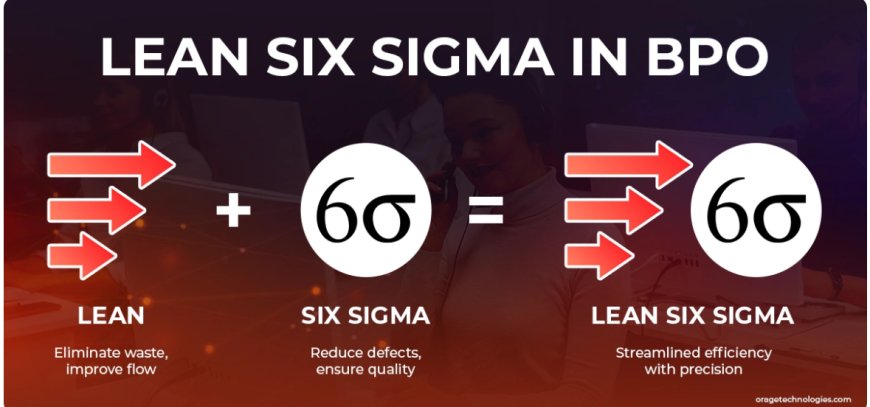
Lean Six Sigma is a framework that unites the two strong strategies: Lean, whose objective is the removal of non-value-added activities (waste), and Six Sigma, whose objective is the elimination of variation and quality improvement through the application of statistical principles. Applied to BPO settings, it provides a framework for the systematic enhancement of workflows and performance.
BPOs perform various activities like customer service, data entry, finance, and IT support. All of these processes can be plagued by inefficiencies like unnecessary steps, unnecessary delays, or errors. Lean Six Sigma identifies and removes these inefficiencies to fuel excellence and cost reductions.
How Lean Six Sigma Operates in a BPO Setting?
Lean Six Sigma in BPOs operates based on the DMAIC cycle:
- Identify the problem or opportunity.
- Review current performance.
- Examine data for root causes.
- Enhance processes based on insights.
- Control to sustain gains.
For instance, if average ticket resolution time is excessively high in a BPO, the DMAIC approach can identify such delays as redundant approvals or non-standard responses and eliminate them.
Aside from problem-solving, Lean Six Sigma also fosters a culture of continuous improvement where teams continually strive to discover better ways of providing value.
What are the most important advantages of Lean Six Sigma to BPOs?
Using Lean Six Sigma can produce transformational outcomes. Some key benefits include:
-
Cost Savings: By cutting inefficiencies, BPOs can save labor, time, and resource costs.
-
Better Quality: With less error and more consistency, customer satisfaction is higher.
-
Improved Turnaround: Effective processes drive towards faster delivery of services.
-
Data-Driven Decisions: Lean Six Sigma encourages decisions based on facts, not assumptions.
-
Increased Employee Engagement: Involvement of the employees in process innovation boosts morale and productivity.
-
Enhanced Compliance: Consistent procedures offer enhanced compliance with regulatory guidelines and service level agreements (SLAs).
Finally, Lean Six Sigma increases the competitiveness and responsiveness of BPOs.
What Are the Challenges BPOs Encounter in Embracing Lean Six Sigma?
While helpful, implementation is not without obstacles. Some typical challenges are:
Resistance to Change: Employees may resist process change or job loss.
Lack of Qualified Experts: Successful implementation requires trained Lean Six Sigma experts.
Inconsistent Data: BPOs operate geographically, and it can be difficult to obtain consistent data.
Short-Term Orientation: Some BPOs are concerned only with short-term outcomes and neglect long-term enhancements.
These challenges may be managed by having good leadership, adequate training, and good communication planning.
How Do BPOs Start with Lean Six Sigma?
BPOs can begin their Lean Six Sigma journey by taking the following steps:
-
Measure Organizational Readiness: Evaluate current performance and change readiness.
Train Teams: Have important personnel go through Yellow Belt, Green Belt, or Black Belt training.
-
Prioritize High-Impact Areas: Focus on processes with frequent errors or delays.
-
Begin Small: Begin with pilot projects to show success as well as build confidence.
-
Scale Gradually: Implement Lean Six Sigma department by department with documented success.
It's also good to have internal champions that are able to champion projects and mentor.
What are Some of the Practical Applications of Lean Six Sigma in BPOs?
A few global BPOs have managed to implement Lean Six Sigma:
- Genpact, a pioneer in the BPO sector, relies heavily on Lean Six Sigma to streamline finance and accounting services, minimizing the rate of errors and processing time.
- Wipro BPO enhanced customer service call handling time and First Call Resolution (FCR) levels by embracing DMAIC practices.
- Infosys BPO applied Lean Six Sigma to enhance invoice processing precision, which saved scores of man-hours per year.
These case studies illustrate that Lean Six Sigma is more than theoryit produces results in the real world.
How is Lean Six Sigma Certification Useful to BPO Professionals?
Lean Six Sigma certified individuals acquire:
- Career Development: Certified employees are likely to be preferred for management roles.
- Analytical Skills: They acquire problem-solving skills with data and tested frameworks.
- Cross-Functional Exposure: The majority of projects involve working with multiple departments.
- Higher Pay: Most organizations provide higher pay to certified professionals.
BPO professionals who know Lean Six Sigma are assets for any outsourcing company.
FAQs on Lean Six Sigma for BPOs
Q1. Can Lean Six Sigma be used in small BPOs?
Yes. Small BPOs can apply Lean principles to streamline operations and reduce expense, and they can begin with low-cost and easy process improvements.
Q2. When should one anticipate seeing the outcomes of Lean Six Sigma?
Results vary based on the project, but any BPO can typically begin noticing improvements 36 months after implementation.
Q3. What is the difference between Lean and Six Sigma?
Lean is aimed at waste removal and quick speed, and Six Sigma is aimed at defect reduction and quality. Together, they provide a balanced approach towards process improvement.
Q4. Does Lean Six Sigma enhance customer satisfaction in BPO?
In fact. Fewer mistakes, quicker service, and repeatable results translate into greater client satisfaction and loyalty.
Conclusion: Should Your BPO Adopt Lean Six Sigma?
In a global economy where operational excellence is no longer a luxury, Lean Six Sigma gives BPOs the mindset and tools they need to succeed. Not only does it drive internal efficiencies, but it also drives customer satisfaction. The path requires discipline and training, but the payoffgreater cost, improved quality, and competitivenessis well worth the expenditure. Whether you have a large BPO business or a small outsourcing business, incorporating Lean Six Sigma might be your recipe for success.
Also Read:What is Offshore BPO: Benefits and Limitations